
Introduction
Attending a performing arts college is an exciting step for students who want to grow their talent and pursue a career in acting, singing, or movement. These programs are filled with creativity, collaboration, and personal development.
However, alongside that excitement comes a set of challenges many students don’t expect.
Even when you feel ready, the reality of training in a high-level artistic environment can be overwhelming at times. Whether you’re studying in Los Angeles or another major creative hub, performing arts colleges push you both artistically and emotionally.
Understanding these challenges ahead of time can help you navigate them with confidence—and keep moving forward when things get tough.
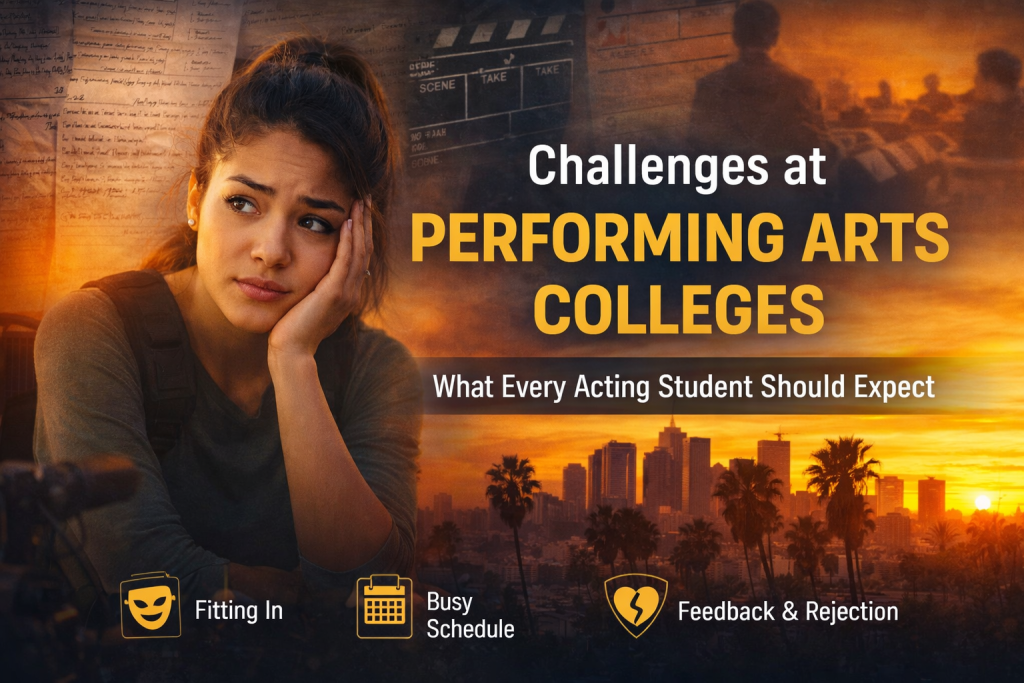
Finding Your Place in a New Environment
Starting at a new school often brings a mix of excitement and uncertainty.
Many students walk in believing everyone else is confident and prepared, while they themselves feel unsure. In reality, most people are experiencing the same thing.
Common early challenges include:
- Feeling like you don’t quite fit in at first
- Missing home, especially during quiet moments
- Adjusting to a fast-paced and unfamiliar environment
Creative spaces can feel intense, especially when surrounded by talented peers. However, feeling out of place doesn’t mean you don’t belong—it usually means you’re in the process of growing.
Balancing Training, Rehearsals, and Life
Performing arts programs are demanding. Between classes, rehearsals, and personal responsibilities, your schedule can quickly become overwhelming.
Students often struggle with:
- Managing a packed daily schedule
- Feeling guilty for taking breaks
- Falling behind academically due to rehearsals or performances
Because your work is tied to your passion, it’s easy to push yourself too hard. However, long-term growth requires balance.
Learning when to rest—and how to recharge—is just as important as showing up and working hard.
Handling Feedback and Rejection
One of the most challenging parts of performing arts education is receiving direct, personal feedback.
Unlike traditional academic programs, feedback here often focuses on:
- Your voice
- Your emotional expression
- Your physical presence
This can feel vulnerable.
Students may also face:
- Not getting roles they worked hard for
- Watching peers succeed while they struggle
- Repeated rejection during auditions
It’s important to remember:
Rejection is not a reflection of your worth—it’s part of the process.
Growth in the arts comes from learning how to receive feedback, adapt, and keep moving forward.
Building Confidence While Improving Skills
At performing arts colleges, everyone is developing their craft. Even so, it’s easy to compare yourself to others.
Students often experience:
- Frustration with slow progress
- Doubt about their abilities
- The feeling of being “behind”
Confidence doesn’t happen overnight. It builds gradually through:
- Consistent practice
- Small improvements
- Repeated experience
When you shift your focus from comparison to personal growth, you begin to develop a stronger, more grounded sense of confidence.
Staying Motivated When Progress Feels Slow
Not every week will feel like a breakthrough.
After the initial excitement fades, many students go through periods where progress feels unclear or slow.
You might find yourself thinking:
- “Am I actually improving?”
- “What if I’m not good enough?”
- “Why does it seem easier for everyone else?”
These moments are completely normal.
Progress in the arts is rarely linear. Often, the biggest growth happens quietly—before it becomes visible.
Staying connected to why you started can help you push through these slower phases.
Growth Happens Through the Challenges
Every challenge you face during your training plays a role in shaping you as an artist.
Moments of doubt, frustration, and uncertainty are not signs of failure—they are signs that you are stepping into something real.
Over time, students develop:
- Emotional resilience
- Creative discipline
- A deeper understanding of their craft
At Los Angeles Acting Conservatory, students train through a comprehensive “Golden Box” approach that blends techniques from Meisner, Strasberg, Adler, Hagen, Chekhov, and Stanislavski—alongside on-camera work, improvisation, and industry preparation.
This kind of structured training helps students navigate challenges while continuing to grow.
Final Thoughts: Trust the Process
Feeling uncertain, overwhelmed, or even discouraged at times doesn’t mean you’re in the wrong place.
In fact, it often means you’re exactly where you need to be.
Performing arts training is not just about learning technique—it’s about developing the mindset, resilience, and confidence required to succeed in a competitive industry.
If you stay committed, stay open, and keep showing up, growth will come.
CTA (Optimized for Conversion)
Thinking about training at performing arts colleges in Los Angeles?
Choose a program that offers:
- Professional acting training for film, TV, and stage
- A supportive environment focused on real growth
- Guidance to help you navigate both craft and career
👉 Request information today and take the next step in your acting journey.
Start Your Acting Career Today-Whether you’re looking for acting classes for beginners, private acting lessons, or advanced training, the key is to start.
Take the first step now: https://www.michelledanner.com/contact-acting-school/
Looking for the best acting classes near you? Our acting school in Los Angeles offers professional training in Meisner acting technique and Stella Adler acting classes, along with children’s acting classes, online acting classes, and personalized coaching. Whether you’re searching for acting classes in LA, top drama schools in Los Angeles, or the best acting schools to launch your career, our programs help actors of all levels build skill, confidence, and a unique artistic voice.
Phone: 310-392-0815
Location: 10820 Washington Blvd, Culver City, CA 90232
Email: [email protected]
Website: michelledanner.com