Stop Letting Old Habits Sabotage Your On-Camera Performance
Strong theater training can be a gift, but it can also cause trouble when you step in front of a camera. The close-up does not care how far your voice can carry or how bold your physical choices are. It cares about what is actually happening in your eyes and in your body, moment to moment. When fall brings a rush of pilot auditions, indie films, and new web projects, old habits can start to cost you work.
In this article, we want to help you spot the signs that your current technique is not serving you on set. We will look at what the camera sees, why some powerful tools from theater class can backfire, and how shifting your focus can make your work more truthful and specific. If you notice yourself in any of these patterns, it may be time to adjust your training with on-camera focused acting classes in Los Angeles.
When Powerful Emotions Look False on Camera
Big emotion can feel great in your body, yet look fake on screen. A lot of actors have been trained to show how strongly they feel. The problem is that HD cameras catch every small push and strain.
Common signs your emotion is being pushed instead of lived include:
- Tight jaw, clenched neck, or shaking chin
- Overactive eyebrows that jump on every word
- Tears that feel forced or timed instead of surprising
- Line readings that sound like a soap opera instead of real life
Another trap is focusing only on your inner work. If you are deep in sense memory or substitution but not really listening to your scene partner, you end up in your own private movie. On playback, it can look like:
- Your reactions do not match what the other person is doing
- Pauses that feel like you are thinking about your prep, not the moment
- Emotional shifts that come out of nowhere, with no clear cause in the scene
Real screen acting needs both emotion and behavior. You want your feelings to show up through simple, grounded actions, not through effort. When your technique supports that mix, your close-ups feel alive, layered, and specific instead of hollow or theatrical.
Stuck in Your Head Instead of in the Moment
Some actors are never messy, but they are never surprising either. Every beat, tactic, and gesture has been planned in rehearsal. On stage, that might still work. On camera, it often feels stiff.
You might be stuck in your head if:
- You hit every line perfectly, but nothing feels dangerous or fresh
- You worry about doing the scene the “right way” instead of playing
- You are listening for your next cue instead of to the other person
- You feel relief when the take is over, rather than curiosity about what just happened
Deep script work is helpful up to a point. Breaking down objectives, obstacles, and backstory can give you a strong foundation. But when that work turns into a checklist, it kills your instincts. Timing gets locked. Reactions feel planned. The camera picks up the thinking instead of the truth.
Training that blends Meisner, Stanislavski, and on-camera technique helps you build a clear structure, then let it go. You learn to trust your preparation, stay present, and let each new moment affect you. That is what brings back spontaneity, even when you are on take eight with a full crew watching.
Theater Habits That Do Not Translate to the Lens
If your roots are in theater, some of your strongest habits may be the ones holding you back on camera. Stage work often asks you to fill a big space. The lens wants the opposite.
Stage habits that can clash with the camera include:
- Projecting your voice as if you are reaching the back row
- Over-articulating every word so the text is crystal clear
- Indicating actions, such as “showing” anger or love, instead of doing something simple
- Using large gestures or pacing to keep the energy up
On a tight frame, these choices can read as “busy.” What felt energized and exciting can look like overacting when you watch the footage. The audience is so close that even small movements carry a lot of weight.
Adapting your instrument for the lens means:
- Letting your natural speaking voice work, instead of pushing volume
- Allowing some words to land softly, like in real conversation
- Trusting stillness, especially in listening moments
- Using your body with intention, rather than filling every silence with movement
When your body and voice are tuned for the camera, your work starts to feel effortless and honest instead of loud or mannered.
Ignoring the Camera as Your Scene Partner
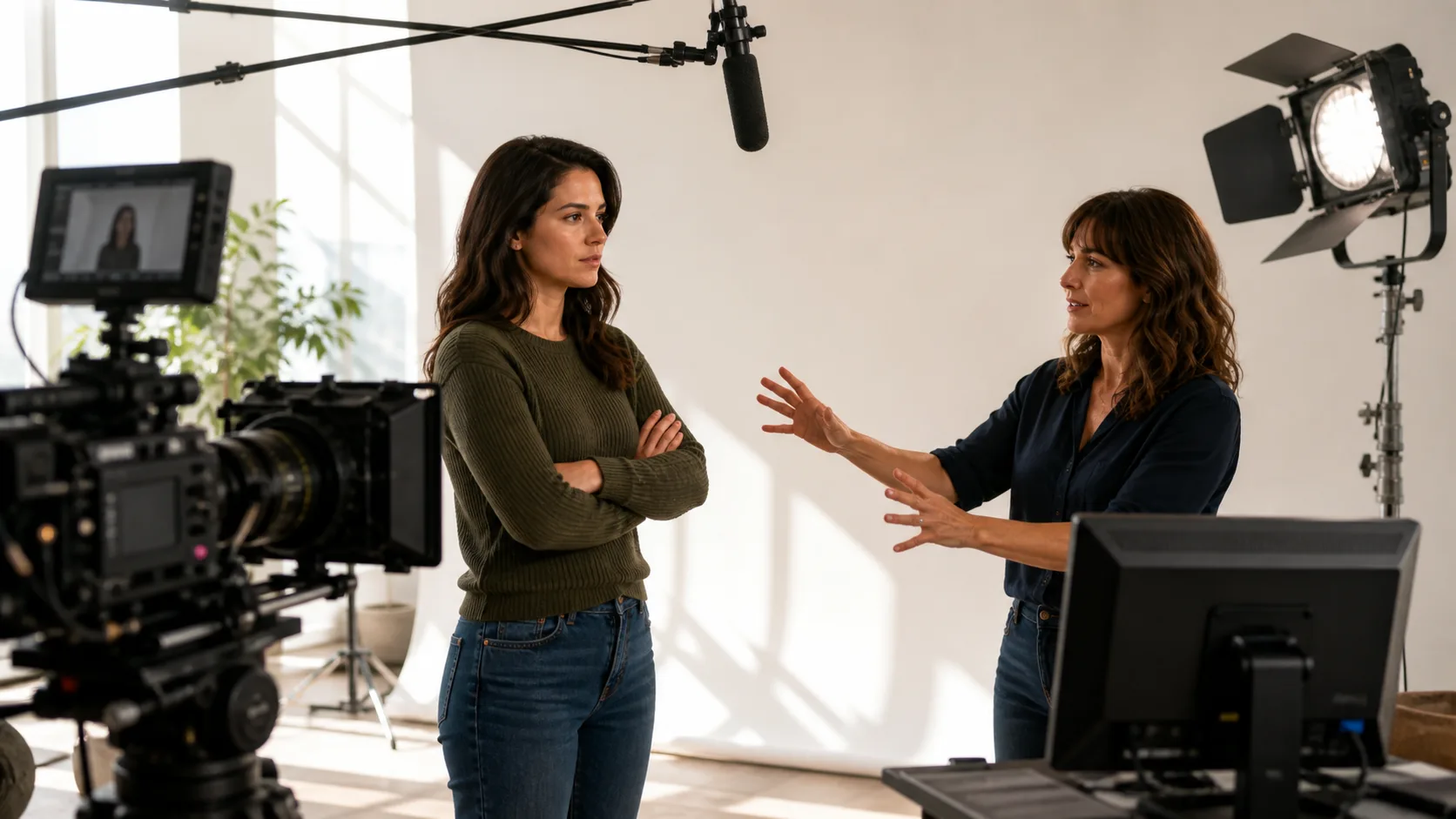
Many actors think of the camera as a cold machine, something to forget. In on-camera work, that is a mistake. The camera is part of the story, and your relationship to it changes how your performance reads.
A few signs you may be ignoring the camera are:
- Your eyeline is slightly off, so it looks like you are talking to someone’s forehead or past their shoulder
- You “cheat out” like you would on stage, turning your body to the audience in a way that feels odd on screen
- Your physical choices do not match the frame size, so a small adjustment looks huge in a close-up
There is also the technical story. If you are not aware of marks, lighting, and blocking, you can cause:
- Continuity problems, like sipping from a cup at different times each take
- Inconsistent performances because your focus shifts as the setup changes
- Extra takes while the director and editor try to match your work from shot to shot
On-camera craft means treating the lens like a partner you respect. When you understand how framing, eyelines, and focus work, you can give the editor clean, truthful moments that cut together smoothly. That awareness is a big part of professional acting classes in Los Angeles that focus on film and TV.
Upgrade Your Technique Before Your Next Self-Tape
Fall often brings a spike in self-tapes, Zoom callbacks, and on-set days. It is a natural reset point, right after summer, when many actors want to step up their work before the year closes. This is a smart time to check if your technique is helping you book or quietly holding you back.
A simple self-check you can do at home:
- Record a short scene or audition side
- Watch it once with sound, then again on mute
- On mute, notice your face, body, and listening. Do you look truthful or busy?
- With sound, listen for pushed emotion, stiff timing, or line readings that feel memorized instead of lived
If you see overacting, stiffness, or a lack of real connection, you are not alone. It usually means your tools were built for a different space and need to be adjusted for the camera. At Michelle Danner Acting Studio in Los Angeles, we work with multiple techniques, including Meisner, Stella Adler, and Stanislavski, and blend them with on-camera training so actors can modernize their craft for film and TV. When your technique serves the lens, your work starts to feel more relaxed, more honest, and much more watchable.
Take The Next Step In Your Acting Career Today
If you are ready to train with working professionals and build real on-camera and stage skills, we invite you to explore our acting classes in Los Angeles. At Michelle Danner Acting Studio, we tailor our training to your goals, whether you are just starting out or leveling up your craft. Reach out to our team with any questions or to discuss the best class fit for you by using our contact page.