
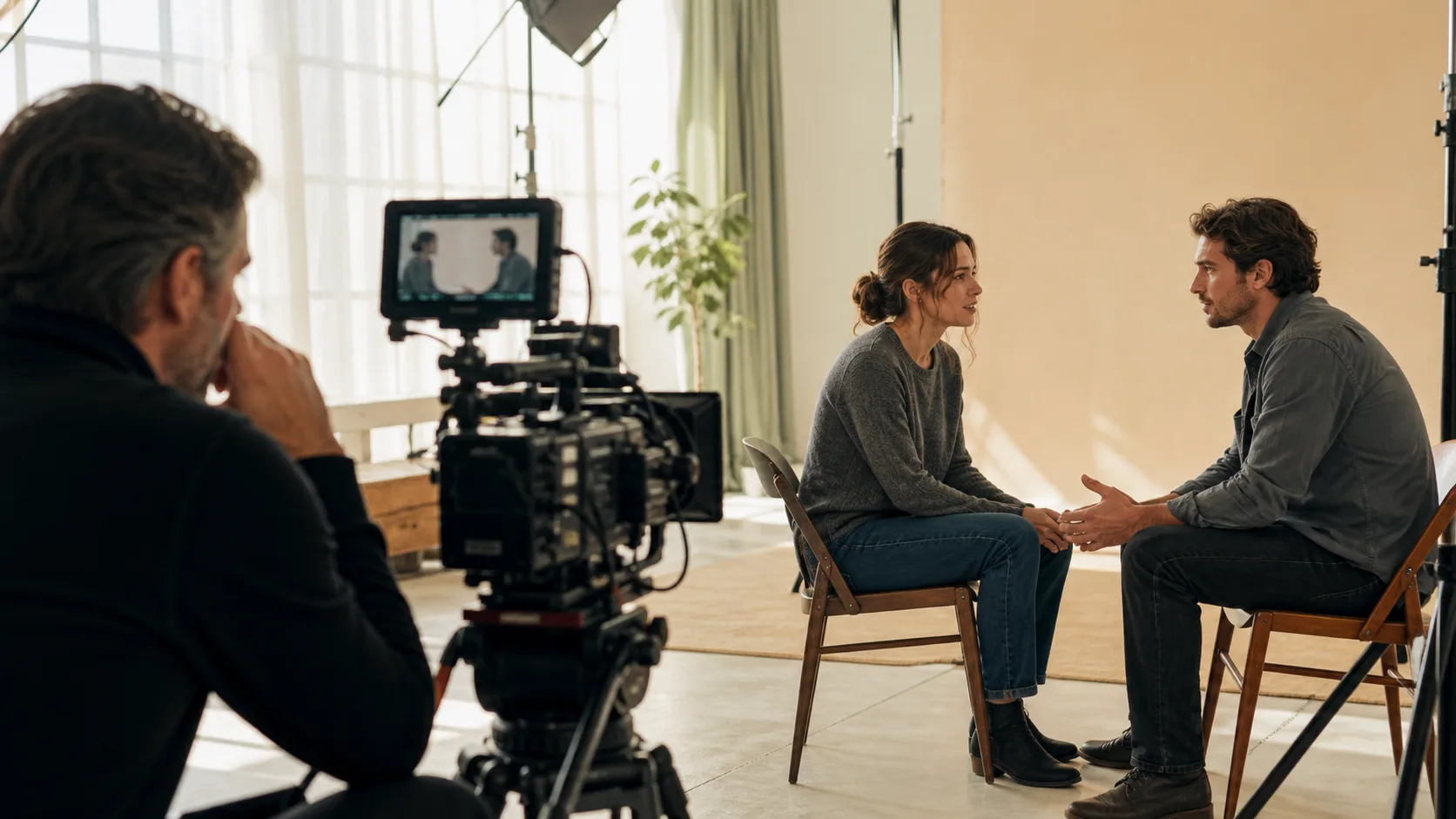
Build Truthful Behavior That Reads on Camera
Balancing the Meisner acting technique with on-camera work can feel tricky. In class, you may feel free, big, and open. Then the red light comes on, and suddenly you worry you are doing too much, or not enough. The good news is that the core of Meisner is exactly what film and TV need: truthful behavior that feels alive right now.
Fall is a great time to sharpen both sides of your craft. Casting is busy with pilots, streaming projects, and holiday campaigns. So this is the moment to ask: how do we take all that honest, moment-to-moment work and make it land inside a camera frame? We will walk through how Meisner really works, how to adjust it for the lens, common traps to avoid in auditions and self-tapes, and simple drills you can bring into class or onto set.
Foundations of the Meisner Acting Technique
At its heart, the Meisner acting technique is about living truthfully under imaginary circumstances. That sounds simple, but it asks a lot from us. It asks us to stop planning, stop posing, and start really listening.
Core tools in Meisner include:
- Repetition exercises that train you to respond to the other person
- Independent activities that demand real focus on something important to you
- Emotional preparation so you enter the scene with a real inner life
- Working off the other person instead of off an idea of how the scene should go
Repetition builds sharp listening. You stop waiting for your turn to talk. You notice tiny shifts in the other actor and let them affect you. On camera, that kind of listening is gold, especially in close-ups where the audience can see every flicker in your eyes.
Independent activities teach you to make tasks matter. You are not pretending to care about the thing in your hands; you actually care. That commitment reads strongly on screen, even when you barely move.
A big misunderstanding is that Meisner is all about being emotional or intense. It is not about chasing tears. It is about truthful connection. Sometimes that means high emotion, but many times it means one quiet look, a small breath, or a tiny change in focus. On camera, those small shifts can hit very hard.
Translating Meisner Truth to the Camera Frame
Once you grasp the basics, the next step is learning how that same truth fits inside different shots. The inner life stays full, but the behavior changes size.
Think about scale:
- Wide shot: Your whole body is in frame, so clean physical behavior helps tell the story
- Medium shot: The audience sees from the waist or chest up, so gestures and posture matter more than big movements
- Close-up: The camera lives on your face, so tiny shifts in eyes, breath, and thought carry the scene
The mistake many actors make is trying to feel “more” in a close-up. What we need instead is to let the same honest work live in a smaller container. The energy does not go away, it just does not leak out everywhere.
Technical awareness also becomes part of the job. On set, you deal with:
- Eyelines: Where you look so it matches the story
- Frame lines: How much of you the camera sees
- Marks: Where you land so you stay in focus and in light
- Continuity: Repeat behavior when angles and takes change
If you focus only on these marks, you can start to indicate or pose. If you ignore them, you can ruin the shot. The goal is to fold all this into your Meisner base. You stay in the moment, but you also know where the frame ends and what the camera can see.
A helpful drill is to film your repetition and scene work on a smartphone:
- Shoot a wide, a medium, and a close-up of the same moment
- Watch the playback and notice what feels truthful and what feels big
- Gently trim any extra gestures, head tilts, or facial tension that look stagey
You are not trying to be smaller, just clearer. The camera does the rest.
Avoiding Common On-Camera Pitfalls for Meisner Actors
When you train strongly in Meisner, some patterns can sneak into your on-camera work. The goal is not to throw away your training, but to refine how it shows up.
One common issue is over-projection and over-physicality. In a classroom or stage setting, your voice and body may grow to fill the space. On camera, especially in a close-up, that same energy can feel like shouting at the audience.
You can adjust by:
- Letting your voice land at the other person, not the back row in your mind
- Releasing extra tension in the jaw, shoulders, and hands
- Allowing stillness so the emotion sits in your eyes and breath
Another trap is emotional pushing. You might try to “recreate” a big breakthrough you had in class. On screen, that often reads as forced. Meisner work teaches us to trust the preparation, then let go. Do your emotional work before the take, connect with your partner, and then allow whatever happens to be enough.
Strong impulse work can also lead to continuity problems. Maybe in one take you slam the cup, in the next you sip it gently. Editors need some consistency to cut the scene together. To balance this:
- Lock a few key physical choices that are tied to the story beat
- Leave everything else free to change slightly from take to take
- Use your listening so each repeat feels fresh, even with the same broad pattern
You are still spontaneous, just inside a frame that the crew can work with.
Blending Meisner Training With On-Camera Technique
Meisner does not need to live alone. It blends well with other approaches like Stella Adler and Stanislavski, along with focused on-camera work. These methods can support your instincts so they hold up across different formats like multi-cam comedy, single-cam shows, and streaming dramas.
It helps to train in a place where you can:
- Do repetition and emotional work
- Study scene structure and script analysis
- Practice self-tapes and on-camera auditions
- Get feedback that covers both your truth and your technique
In the fall, many actors build a simple training plan, for example:
- One scene study or Meisner-based class each week
- One on-camera or audition-focused class each week
- Regular time to film and review short scenes or self-tapes
- A quiet week during holiday breaks to review progress and reset goals
This rhythm lets you keep your Meisner muscles strong while you grow the technical skills that help you book.
Here in Los Angeles, where film and TV work stays active through much of the year, having both sides of this training can make a real difference in how ready you feel when opportunities show up.
Turning Meisner Training Into Bookable On-Camera Work
The real win is not choosing between Meisner and the camera. It is learning to let your truthful, in-the-moment work live comfortably inside the lens. You do not need to change who you are as an artist. You just need enough technical skill so casting directors and directors can fully see what you bring.
Small, clear steps tend to work best. Many actors pick one or two focused moves for the season, like committing to an on-camera class, filming a Meisner-based scene each week, or booking a coaching session before a big audition. Over time, those choices add up to a craft that feels both free and professional.
At Michelle Danner Acting Studio in Los Angeles, we care deeply about that balance. Our goal is that the same honest, present-tense work you do in class shows up on screen as performances that feel real, specific, and ready for the demands of film and TV.
Take the Next Step Toward Honest, Connected Acting
If you are ready to train with a method that sharpens your instincts and deepens your emotional truth, explore our Meisner acting technique classes at Michelle Danner Acting Studio. We will help you build reliable, repeatable skills you can bring to every audition and performance. Have questions about schedules, levels, or how to get started, simply contact us and we will guide you to the best next step for your goals.